Showing posts with label Strategies. Show all posts

Wednesday, July 22, 2015

Display: Turn & Talk

Turn and Talk is a great strategy to use in the classroom. Students are given a chance to discuss their ideas with a partner.

Here are some of the benefits of Turn and Talks or Think-Pair-Shares:

  • Every student gets to share his or her ideas.
  • Students can build ideas and knowledge off of each other.
  • Students can learn from their peers.
  • It helps to build a classroom community.
  • Providing a chance of dialogue in the classroom can decrease out-of-turn talking, or other disruptive behaviors.
  • It is an easy check-in. Listening in can serve as a formative assessment to see if the students are understanding.
  • Builds communication and speaking skills.

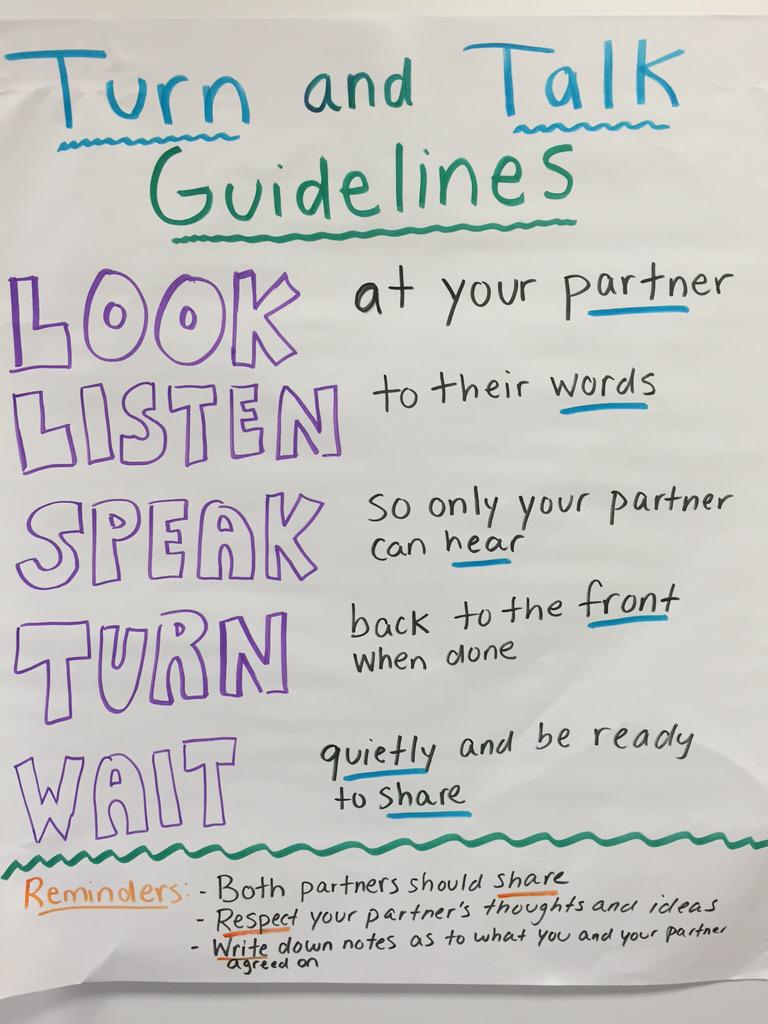
Check out this anchor chart with Turn and Talk guidelines and expectations.

Friday, March 6, 2015

Interview: Special Education

Here are some Frequently Asked Questions (FAQs) about special education. The post is set up in a question and answer format. These answers were last updated in 2013.  The source to many of these answers come from Teaching Students with Special Needs in an Inclusive Setting.

Define and describe special education. 

Special education is specially designed instruction provided by the school district or another local education agency that meets the unique needs of students identified as disabled according to federal and state eligibility criteria. 

Define differentiated instruction and explain its usefulness in meeting the needs of a diverse classroom.

Differentiated instruction is “the planning of curriculum and instruction using strategies that address student strengths, interests, skills, and readiness in flexible learning environments.” It is a “philosophy that guides your thoughts about, and actions with, children in the classroom” (167). Differentiated instruction is important because it tailors teaching to meet the needs of all the students in the class. Typically, teachers will teach to one set of students, but everybody in the class learns differently. Differentiated instruction meets all of the needs of the students in the class.

Essay: Banking and Problem-Posing Concept

This essay was originally written in 2013.

In chapter two of Pedagogy of the Oppressed, author Paulo Freire discusses what he feels is an important educational issue. Freire's chapter focuses on two types of teaching: the banking and problem-posing methods. He clearly believes that one form of education is better than the other. Freire strongly criticizes the banking approach, but genuinely supports the problem-posing method.

To open his discussion, Freire starts with a brief scenario and description introducing the banking approach. He describes the banking concept of education as teachers depositing information into the heads of students, who are only capable of receiving the information. Banking is when teachers talk and lecture, and the students simply memorize what is being said. Through this process, students will not understand the meaning behind an answer. They will not know how an answer is derived, nor why something is the way it is. Students will not fully comprehend an explanation; they will just memorize facts without understanding the reason or significance. No critical thinking is involved with banking. Freire shames the approach for these reasons.

Freire strongly criticizes the banking method throughout the chapter. He believes that memorizing minimizes creativity. Students are not able to think outside the box when they are absorbing a teacher's rant. Students do not have the opportunity to think hardly about something with banking. Freire believes that this is a problem because it will eventually lead to students accepting the world, which will basically be handed to them. Those who are depositing the information may want this since it keeps everything the same, but students won't be able to have their own thoughts or interpretations with banking. Freire goes on to mention an alternative to the banking method.

Tuesday, February 17, 2015

Sample: Inquiry Chart

An Inquiry Chart, or I-chart, is defined by Reading Rockets as "a strategy that enables students to gather information about a topic from several sources. Teachers design the I-chart around several questions about a topic. Students read or listen to several sources on the topic and record answers to the posed questions within the I-chart."

Depending on the grade level, the teacher can provide the questions, or the students could create their own.  The sources should not be limited to simply text and instruction. For example, videos make a great resource for I-charts. Also depending on the grade level, students could be assigned sources, or choose their own.

Below is an example of a completed science Inquiry Chart on the topic of weather.    

Wednesday, October 15, 2014

Lesson Plan: Written Discussion

This lesson was originally taught to an undergraduate class at a university.  The lesson taught aspiring teachers how to use written discussion as a reading strategy.  The strategy can easily be used in any subject area or grade level. A Power Point and links to resources are attached.

Title: Mini-lesson: Written Discussion

Introduction of Lesson Goal/Objective: 

· Students will be able to respond to a text through written discussion by working independently & in small groups.
· Students will be able to discuss an article based off a written conversation started within a small group.

Start by asking, “Has anybody used an online forum or message board to respond to a reading?” to link the lesson to previous learning. Ask: “What site did you use and what were your experiences?”  Have a few students share their experiences to the class.  Then, explain that an online forum is very similar to a reading strategy called “written discussion.”  Explain that message boards are essentially an online version of the strategy.

State that students will learn about a reading strategy called “written discussion,” which they will use while reading a text. Explain that written discussion is important because it allows every student to read, write, think, and share. It improves comprehension because it lets students react to what they have read.  Mention that it is an alternative to a whole class discussion, as it enables all students to participate rather than a select few.

Model the Objective:  Read “Flappy Bird Will Fly Back to App Stores” aloud.  Using Microsoft Word, write a response to the text, labeled “Student #1.”  Then, “Student #2,” will write a response to “Student #1.” Explain that the class will be doing this activity on a regular piece of paper, which will be passed more than once.  Mention that students will discuss the conversations aloud.


Sunday, July 20, 2014

Lesson Plan: Fluency & Echo Choral Reading

The following lesson was co-planned with Matt W. and Rachel D.  The lesson uses echo choral reading to help elementary students with reading fluency. The lesson includes background information on reading fluently.

Strategy Lesson: Fluency Using Echo Choral Reading
Grade Level: 2 (can be adapted for other grade levels)

Introduction:      

Fluent reading is the ability for students to read text accurately with no grammatical errors.  Students are able to read text without taking long pauses in between words and are able to fully recite sentences as they appear in the text. Fluent reading also means that if the student makes any errors they are usually small grammatical errors and they are able to fix them up themselves through self-correction.

The strategy we are going to use to demonstrate fluent reading in classmates is choral or echo reading. This strategy is great to allow students to develop fluent reading strategies since the technique helps students to develop a stronger vocabulary including sight words as well as how to properly phrase and construct sentences through learned repetition.


Saturday, March 15, 2014

Lesson Plan: Maniac Magee (Chapters 1-4), Semantic Mapping, Vocabulary

This is a jammed-packed lesson, as it is part of a unit plan. The lesson plan has three lessons in one: a before/during/after reading of the first four chapters of Maniac Magee, a lesson on semantic mapping, and a lesson on vocabulary from Maniac Magee. The three lessons were intertwined to create part of a unit plan. The lesson is intended for sixth grade students, but can be adapted for any grade level reading Maniac Magee. The lesson also includes outside sources and a reflection on planning.  The lesson is embedded below.